
If you’ve been in industrial fluid handling long enough, you’ve probably run into a Sulzer pump at some point maybe without even realizing it. Sulzer has been building pumps since 1834, and that kind of track record doesn’t happen by accident. Their equipment shows up in some of the most demanding process environments on the planet: oil refineries, paper mills, water treatment plants, chemical facilities. Places where a pump failure isn’t just inconvenient it shuts things down.
But here’s where a lot of buyers get stuck. Sulzer makes a wide range of pump models, and figuring out which one actually fits your application takes more than a quick Google search. The APT, ZPP, and MCA series all serve different purposes, and picking the wrong one means you’re either overpaying for capability you don’t need or running a pump outside its design envelope neither of which ends well.
This guide breaks down each model clearly, so you can walk away knowing which Sulzer pump makes sense for your operation.
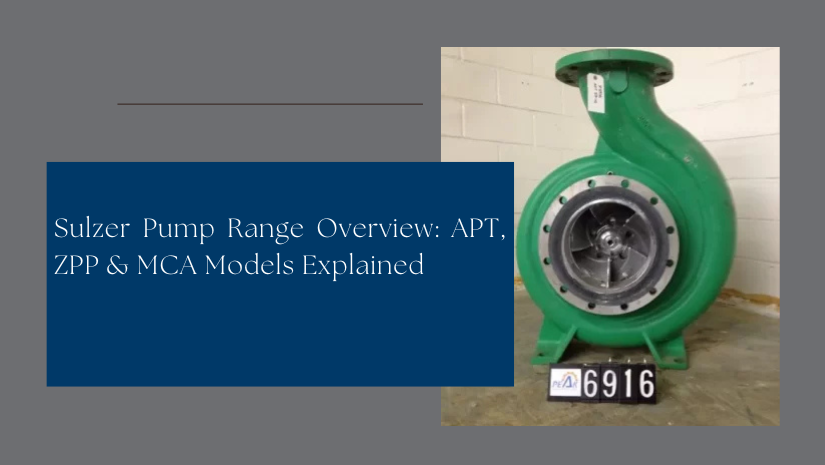
Before getting into individual models, it’s worth understanding why Sulzer has stayed at the top of the pump industry for this long.
It comes down to engineering consistency. Sulzer doesn’t chase trends they build pumps around what actually works in real process environments. Their hydraulic designs are developed and refined over decades of field data, not just laboratory curves. That means when you install a Sulzer pump, you’re getting performance that has been validated in conditions similar to yours, not just optimized for a spec sheet.
They also invest heavily in materials science and seal technology, which matters enormously when you’re pumping corrosive chemicals, high-temperature fluids, or abrasive slurries. The result is a pump range that holds up and that’s exactly what industrial buyers care about.
The Sulzer APT pump is where Sulzer’s deep experience in pulp and paper manufacturing really shows. APT stands for Advanced Process Technology, and the design is purpose-specific this pump was developed to handle the hydraulic challenges that are unique to paper mill environments.
What makes it different from a standard process pump?
Paper mills deal with process fluids that most pumps weren’t designed for. You’ve got medium-consistency fiber stock, white water loaded with fine fibers, chemicals that can be mildly corrosive, and process conditions where air entrainment and cavitation are constant risks. A general-purpose ANSI pump can handle some of this, but it won’t do it efficiently over the long term.
The APT was engineered specifically around these conditions. Its impeller geometry is optimized to minimize cavitation risk even when suction head is limited which it often is in basement and pit installations common in paper mills. The hydraulic design prioritizes sustained efficiency over extended operating periods, which matters a lot in facilities where pumps run continuously, 24 hours a day.
Typical APT applications include:
Why operators choose the APT:
Maintenance managers who work with APT pumps consistently point to two things: they run reliably without constant attention, and when service is needed, the design makes it straightforward. In a paper mill where production schedules are tight and downtime is expensive, that combination is hard to overvalue.
The APT is also specified as OEM equipment in many Ahlstrom-designed mill systems, which means if you’re running one of those facilities, the APT is often the most direct and compatible replacement option when older pumps reach the end of their service life.
If the APT is built for pulp and paper, the Sulzer ZPP is built for the applications where things get genuinely difficult high temperatures, aggressive chemicals, demanding pressure requirements, or some combination of all three.
The ZPP is a between-bearings centrifugal pump, meaning the impeller sits between two bearing assemblies rather than being overhung on one side. This design matters because it provides superior shaft stability under high loads, reduces vibration, and extends bearing and seal life compared to end-suction designs running in similar conditions.
Where the ZPP earns its keep:
Chemical processing is the natural home of the ZPP. When you’re pumping aggressive acids, high-temperature process streams, or fluids with specific material compatibility requirements, the ZPP’s construction options and engineering heritage make it a strong choice.
You’ll also find the ZPP in:
What sets the ZPP apart technically:
The between-bearings design isn’t just about shaft stability it also allows for larger impeller diameters without the deflection issues that limit overhung pump designs at high flow rates or pressures. This means the ZPP can handle serious performance requirements without compromising on reliability or seal life.
Material options range from standard cast iron and stainless steel through to high-alloy and exotic materials for the most corrosive service conditions. Mechanical seal configurations are flexible, and the pump can be adapted to meet specific process and safety requirements including API 610 compliance for refinery and petrochemical applications.
A practical point worth making:
The ZPP is not a pump you’d spec for a simple water transfer application. It’s engineered for demanding service, and the upfront cost reflects that. But in applications where the process fluid is aggressive, temperatures are elevated, or reliability requirements are strict, the ZPP pays for itself through reduced maintenance costs and fewer unplanned outages.
Not every application needs the specialization of an APT or the heavy-duty engineering of a ZPP. A large portion of industrial fluid handling involves clean or mildly challenging fluids, moderate pressures and temperatures, and a need for reliable performance without a premium price tag. That’s where the Sulzer MCA pump fits.
The MCA is a single-stage end-suction centrifugal pump designed for general industrial service. Think of it as Sulzer’s answer to the workhorse pump segment built to Sulzer’s quality standards, but optimized for cost-effective deployment across a wide range of standard applications.
Where you’ll find MCA pumps:
What makes the MCA worth considering over cheaper alternatives:
The MCA competes in a segment that has plenty of low-cost options. What Sulzer brings to the table is the engineering consistency and quality control that comes with a manufacturer that builds pumps for refineries and paper mills. The materials are properly specified, the hydraulic design is validated, and the build quality reflects a company that takes reliability seriously.
For plant managers who have dealt with cheap pumps that fail ahead of schedule or perform below their rated curves in real conditions, the MCA represents a sensible middle ground not overbuilt for the application, but built to actually last.
The MCA is also easy to maintain. Parts availability is good, the design is straightforward, and service doesn’t require specialist knowledge. In facilities where maintenance teams are stretched, that simplicity is genuinely valuable.
Here’s a straightforward way to think about the decision:
Go with the Sulzer APT if your operation is in pulp and paper, or you’re dealing with process fluids that are fiber-laden, air-entrained, or require the specific hydraulic characteristics the APT was designed around. It’s also the obvious choice if you’re running an Ahlstrom-designed mill system and need OEM-compatible replacement equipment.
Go with the Sulzer ZPP if your application involves aggressive chemicals, elevated temperatures, high pressures, or API 610 compliance requirements. If the process fluid would damage or degrade a standard pump quickly, the ZPP’s construction and design are worth the investment.
Go with the Sulzer MCA if your application is more straightforward clean or mildly challenging fluids, standard industrial conditions, and a need for reliable performance at a sensible cost. It’s the right pump for the job when you don’t need the specialization of the other models.
The worst outcome in pump selection is over-engineering a simple application (wasting budget) or under-specifying a demanding one (paying for it in maintenance and downtime). Getting this decision right upfront saves money over the full equipment lifecycle.
Whichever Sulzer pump model you’re considering, a few things are worth confirming before you commit:
Process fluid properties. Temperature, corrosivity, viscosity, solids content all of these affect material selection and seal configuration. Be specific, not approximate.
Flow and head requirements. Pull your system curve data and make sure the pump’s operating point sits in the efficient zone of its performance curve not at the edges where efficiency drops and wear accelerates.
Installation constraints. Available suction head, footprint, connection sizes, driver type confirm this match before ordering, especially on replacement projects.
New vs. certified used. For some applications, a properly inspected and reconditioned Sulzer pump is a smart way to get proven equipment at a lower cost. Peak Machinery carries certified used industrial pumps and can advise on whether a used unit makes sense for your specific situation.
Sulzer has built a pump range that covers a lot of ground from the specialized APT for pulp and paper, to the heavy-duty ZPP for demanding chemical and industrial service, to the practical MCA for general industrial applications. The right model depends entirely on what your process actually requires, not on which one sounds the most impressive on paper.
If you’re evaluating Sulzer pumps for a new installation, a replacement project, or a facility upgrade, the team at Peak Machinery can help you work through the selection and source the right equipment.
Explore our Sulzer pump inventory at www.peakmachinery.com or get in touch with our Get a Quote.